How much of your company should you give away before Series A, and will your valuation withstand investor questions? These are commercial decisions, not figures to produce from a generic calculator.
Valuing a startup before Series A requires evidence across traction, market size, revenue quality, growth, risk, the funding plan and current market conditions. In the UK, Series A is often the first major institutional round, so your pre-money valuation needs to support both the capital you want to raise and the equity you’re prepared to give up.
Consult EFC’s business valuation for fundraising helps founders build an evidence-backed valuation and financial model before negotiations begin. The process starts with the factors investors will test.
Key Takeaways
- Before Series A, your valuation must be supported by traction, market size, growth, revenue quality, risk and a clear funding plan.
- Pre-revenue startups usually need proxy methods such as Berkus, Scorecard, team strength, market opportunity and milestone progress.
- Revenue-generating startups may use ARR or revenue multiples, but investors will test growth, retention, margins and customer concentration.
- Pre-money valuation determines how much equity you give away, so model the round before negotiating terms.
- Use recognised startup valuation methods alongside a credible forecast, not a generic calculator.
Valuing a Startup Before Series A Investment: What Investors Need to See
A pre-Series A valuation puts a defensible price on your company before new investors subscribe for shares. It affects the amount of equity you give away, the expectations attached to the round and the valuation required at your next fundraise.
Reported UK Series A pre-money valuations often sit around £8m to £40m, with many rounds falling between £10m and £30m. These figures are context, not a promise. Sector, geography, traction, investor appetite and deal terms can move the number sharply.
Your valuation should therefore be supported by evidence, not a preferred headline figure. An independent fundraising valuation strategy can help you organise that evidence before investor discussions begin.
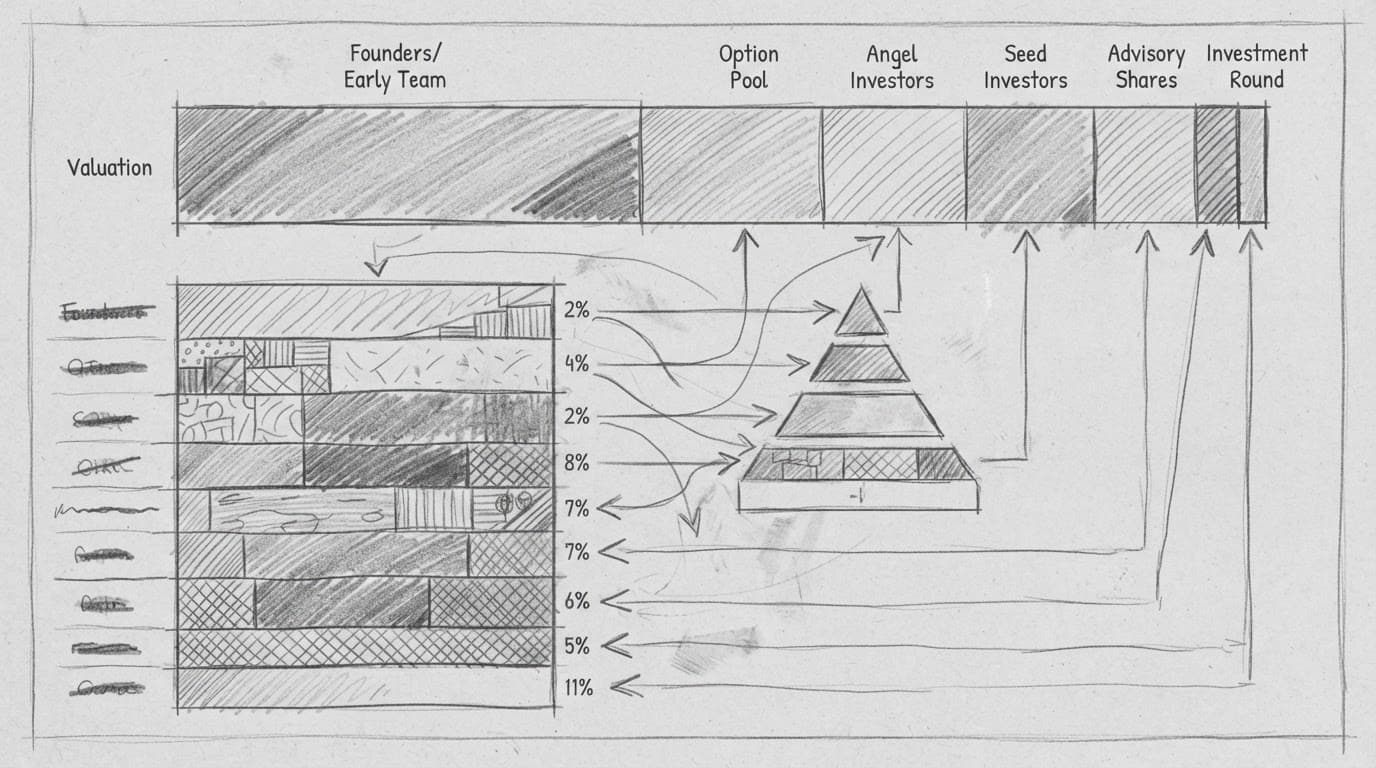 ### Pre-money, post-money and dilution in one simple example
Pre-money valuation is the value of the business immediately before the investment. Post-money valuation is the value immediately after the investment has been added.
Consider a startup with a £12m pre-money valuation that raises £3m in Series A funding:
| Calculation | Amount |
|---|---|
| Pre-money valuation | £12m |
| New investment | £3m |
| Post-money valuation | £15m |
| New investor’s ownership | 20% |
The investor’s 20% is calculated as £3m divided by the £15m post-money valuation. Existing shareholders collectively own the remaining 80%, before considering any option pool adjustment or other securities.
This is where founders need to examine the term sheet carefully. If an option pool is created before the investment, its dilution usually falls mainly on the existing shareholders. If it is created after the investment, the investor shares more of that dilution. The commercial difference can be material, even where the headline valuation stays unchanged.
Your ownership review must cover the full capital structure, not just issued ordinary shares. Check:
- Existing founder and shareholder shares.
- Employee options already granted or reserved.
- Convertible loans and the conversion terms attached to them.
- SAFEs and advance subscription agreements.
- Warrants, preference shares and other rights to acquire shares.
A £12m valuation can produce a very different outcome depending on what converts, which discounts apply and whether the option pool is included in the pre-money calculation. Model the fully diluted cap table before agreeing the round.
Why the stage label is less important than the evidence
Investors don’t value a business simply because it has reached Series A. The label describes the funding stage. It doesn’t prove product-market fit, repeatable sales or a credible path to scale.
For a SaaS company, investors may examine ARR, annual growth, gross and net churn, net revenue retention, gross margin, CAC payback, burn multiple and LTV to CAC. These measures help them assess revenue quality, efficiency and the amount of additional capital the business may require.
The targets vary by sector and business model. A usage-based software company may have different retention patterns from a contract-led SaaS business. A marketplace, fintech company or deep-tech business may need different evidence before revenue becomes predictable.
Investors will also test:
- Whether customers renew, expand and pay on time.
- Whether sales are repeatable without founder involvement.
- Whether revenue is concentrated in one or two accounts.
- Whether the management team has the depth for the next stage.
- Whether the total addressable market supports venture-scale returns.
- Whether the forecast is linked to operational assumptions.
The UK startups and VC landscape evidence pack provides useful market context, but your own metrics remain the stronger valuation evidence. Investors are buying future performance, and they will look for proof that your business can deliver it.
How to Build a Defensible Series A Startup Valuation
A defensible Series A valuation starts with a clean fact base. Investors will test the numbers, the assumptions behind them and the risks that could prevent the forecast from being delivered.
Use several valuation methods together. Early-stage companies rarely have enough trading history for one approach to provide a complete answer.
Gather the numbers and commercial evidence investors will test
Prepare a structured information pack before valuation discussions begin. It should include:
- Monthly management accounts, filed accounts and a reconciliation between the two.
- Revenue by customer, product and contract type.
- ARR or other recurring revenue, bookings, pipeline and recognised revenue.
- Gross margin, churn, retention, expansion revenue and customer concentration.
- CAC, sales capacity, sales-cycle length and conversion rates.
- Headcount, planned hires, cash balance, monthly burn rate and runway.
- Intellectual property ownership, key customer contracts and regulatory risks.
- Founder dependence, including sales, product, technical and operational responsibilities.
The detail matters. £1m of ARR spread across 100 customers is different from £1m generated by two accounts. A strong pipeline is not contracted revenue. Bookings are not necessarily recognised revenue. Your valuation needs to distinguish each measure clearly.
Filed accounts show the reported financial position. Management accounts explain current trading. The forecast sets out what you expect to happen next. These documents must tell the same story. If filed accounts show falling margins but the forecast assumes rapid margin improvement without explanation, investors will challenge the model.
A forecast isn’t credible because it is ambitious. It is credible when each major assumption links to an operational action or an existing data point.
Keep supporting evidence for customer renewals, signed contracts, pricing changes, payroll, intellectual property assignments and regulatory approvals. Weak documentation creates valuation risk even where the underlying business is sound.
 ### Choose valuation methods that fit the startup
The method should match the business, its maturity and the quality of available evidence. The five common SME valuation methods provide a useful framework, but Series A companies need particular care.
For a scalable software business with meaningful recurring revenue, ARR or revenue multiples are usually the clearest starting point. The multiple must reflect growth, retention, gross margin, customer concentration, capital efficiency and market conditions. A higher ARR alone doesn’t justify a higher valuation.
A discounted cash flow (DCF) can help where future cash flows are forecast with reasonable care. It is less reliable when small changes in churn, pricing or hiring produce large changes in the result. Use it as an evidence-based cross-check, not as a way to justify an unsupported terminal value.
Comparable transactions and recent funding rounds provide market evidence. Review the sector, geography, stage, growth rate and deal terms before applying any comparison. Broader venture conditions also matter, so current market reports such as SVB’s State of the Markets Report can provide useful context.
EBITDA multiples and asset-based methods may be less useful for a loss-making technology startup. They can still provide a sense check for asset-heavy businesses, profitable companies or sectors where tangible assets and normalised earnings carry greater weight. Don’t force normalised earnings into a model where the business has no stable earnings base.
Stress-test the forecast instead of presenting one perfect case
Prepare base, upside and downside cases. Each case should change the operating assumptions, not just apply a different valuation multiple.
| Assumption | Downside | Base | Upside |
|---|---|---|---|
| Sales conversion | 10% | 15% | 20% |
| Annual churn | 15% | 8% | 4% |
| Gross margin | 55% | 65% | 72% |
| Monthly hiring | 3 people | 2 people | 1 person |
| Funding timing | Month 9 | Month 6 | Month 4 |
Show how each case affects revenue, cash runway, valuation and founder dilution. Explain the evidence behind every major assumption. A 15% conversion rate should link to historical performance, qualified pipeline or a clearly documented sales plan.
Funding timing also matters. If the round closes three months later, the company may need to reduce hiring, accept a lower valuation or raise more capital. Investors will trust a model that acknowledges these outcomes. They will question one that assumes perfect pricing, low churn, immediate hiring and funding on schedule.
What Drives a Higher or Lower Pre-Series A Valuation in the UK
A higher pre-Series A valuation is supported by evidence that the business can grow without taking disproportionate amounts of capital or carrying avoidable risk. Investors will assess the numbers, but they will also test how reliable those numbers are.
Reported UK benchmarks provide context. Series A raises are commonly around £2m to £10m, with investors taking approximately 15% to 25%. The reported 2025 median Series A post-money valuation was £17.1m. These are broad benchmarks, not a substitute for company-specific analysis. The British Business Bank’s Small Business Equity Tracker provides wider UK equity market context, but your own trading evidence will carry more weight in the room.
Traction, market size and unit economics that support value
Recurring revenue is usually stronger evidence than one-off sales because it gives investors visibility over future income. The quality of that revenue matters. A company with strong growth from a credible customer base, low churn and net revenue retention above 100% has a clearer case than one growing only through constant new customer acquisition.
Investors will examine whether customers renew, expand their spending and pay on time. They will also review gross margins, customer acquisition cost, sales-cycle length and the time required to recover acquisition spend. Some UK benchmarks cite:
- LTV to CAC above 3x.
- CAC payback within 12 to 18 months.
- A burn multiple below 2x.
These figures are useful reference points, not automatic pass or fail tests. A fintech business, marketplace or deep-tech company may have different economics from a SaaS company. Investors interpret metrics in sector context, alongside growth quality and the capital needed to reach the next milestone.
A large addressable market supports valuation only when the company has a credible route into it. Explain the target customer, pricing model, distribution channel, sales capacity and expected expansion. A large market with no repeatable route to scale is an attractive presentation slide, not valuation evidence.
London and the South East can attract a premium because of investor access, specialist talent, established networks and higher funding activity. Geography alone doesn’t create value. A strong company outside those areas can still command serious interest, whilst a London-based business with weak retention and poor margins will face the same questions as any other company.
Risks that can cut the valuation or delay the round
Weak retention is one of the clearest valuation risks. High churn, heavy discounting or dependence on a small number of customers makes forecast revenue less reliable. Long sales cycles can create the same problem by delaying cash generation and increasing the capital required before scale.
Due diligence can also expose risks that aren’t visible in the pitch deck. Check that the company owns its intellectual property, employment agreements are complete and financial controls produce accurate monthly reporting. Founder dependence, excessive burn, unrealistic forecasts, regulatory exposure and a crowded market can all reduce negotiating power.
A clean operating model cannot compensate for an unclear ownership structure.
A messy cap table creates further uncertainty. Unresolved shareholder rights, disputed transfers, unallocated options or previous convertible instruments can change who owns what after the round. Discounts, valuation caps, accrued interest and conversion triggers may alter the effective dilution even when the headline valuation appears acceptable.
Prepare a fully diluted cap table before investor meetings. Include founder shares, employee options, warrants, preference rights, convertible loans and advance subscription agreements. Investors are more likely to trust a valuation that is supported by clean records, documented assumptions and a clear funding plan. Consult EFC can help you prepare the valuation evidence and financial model before negotiations begin.
How Founders Should Prepare for Negotiation and Due Diligence
Your valuation range is only as credible as the evidence behind it. Before investor meetings, prepare the financial, commercial and legal information that supports the valuation and shows how the new capital will create the next step in the company’s growth.
Build a valuation pack that tells one clear story
A strong valuation pack is not a collection of disconnected spreadsheets. It should show where the business is today, what the funding will achieve and why the proposed valuation range is reasonable.
Include:
- A fully diluted ownership table, including shares, options, SAFEs, convertible loans, warrants and the proposed option pool.
- Historic financials, including management accounts, filed accounts, cash flow and bank reconciliations.
- An integrated financial model linking revenue, headcount, gross margin, operating costs, cash burn and runway.
- A KPI dashboard covering revenue, ARR, growth, churn, retention, gross margin, CAC, payback period and customer concentration.
- A use-of-funds plan that connects each major spend item to a commercial objective.
- A milestone roadmap showing the targets the round is expected to deliver.
- Market evidence, including customer research, pricing data, sector information and the route to scale.
- Comparable companies and relevant transactions, with an explanation of why each comparison is appropriate.
- A risk register showing the main risks, their potential effect and the mitigation actions already underway.
The model and the roadmap must agree. If the plan assumes six new sales hires, the forecast should show the cost, ramp-up period and expected contribution. If the funding is intended to reach £5m ARR, explain the customer numbers, pricing and sales capacity required to reach it.
A concise valuation report can help you defend the range without turning every investor question into a fresh analysis exercise. It should set out the methods used, key assumptions, supporting evidence, sensitivity analysis and gaps that still need attention. Consult EFC provides independent, ICAEW-grade valuation support for UK SMEs and start-ups, with a practical focus on evidence that can withstand investor review.
 Due diligence should not be the first time you discover an unsigned IP assignment, an inconsistent cap table or an unexplained tax query. Review the likely requests in advance and place the supporting documents in a properly organised data room. A practical UK due diligence guide covers the records investors commonly request across finance, ownership, IP, tax, governance and employment.
Avoid these common mistakes before approaching investors
Several mistakes weaken a valuation before negotiations have properly started. Relying on an online calculator produces a number, not a defensible conclusion. Copying a competitor’s valuation ignores differences in growth, margins, retention, market access and deal terms. Valuing only the idea is equally weak once investors expect evidence of execution.
A high valuation is not automatically a good deal. Review the complete term sheet, including liquidation preferences, anti-dilution rights, board control, veto rights, option pool treatment, founder vesting and investor information rights. A higher headline figure can be poor value if the terms restrict future fundraising or transfer disproportionate risk to existing shareholders.
Don’t ignore option pool dilution, overstate the total addressable market or hide poor metrics. Investors will test these points in diligence. An honest valuation range is more credible than a precise number that the evidence cannot support.
Before the meeting, confirm that:
- The cap table reconciles to Companies House records and signed documents.
- The financial model agrees with management accounts and bank records.
- Revenue, churn, margins and customer concentration are clearly defined.
- Every use-of-funds item links to a milestone.
- Known risks have an owner and a documented mitigation plan.
- You know your minimum acceptable terms, not only your preferred valuation.
- The company can explain what happens if the round closes late or raises less than planned.
The valuation red flags investors check should be resolved where possible, disclosed where necessary and never left for an investor to find first.
Frequently Asked Questions
A Series A valuation is not settled by one formula or one investor conversation. These questions address the practical issues founders often face after preparing their numbers, forecast and cap table.
 ### What if an investor offers a lower valuation than expected?
Treat the offer as evidence about investor perception, not as proof that your valuation work is wrong. Ask which assumptions, metrics or risks have led to the lower figure, then compare that feedback with your own evidence.
You may be able to improve the terms by narrowing the funding requirement, extending the runway before the round or securing stronger customer commitments. A lower valuation with clean terms can be better than a higher headline figure with a large option pool, aggressive preferences or restrictive control rights.
Should I raise less money to reduce dilution?
Possibly, but only if the smaller round still funds a meaningful milestone. Raising £2m instead of £3m may reduce dilution, but it can leave the company needing another fundraise before reaching the evidence required for a higher valuation.
Model both options using realistic hiring, sales and product assumptions. The right amount is the capital required to reach the next fundable position, with a sensible cash buffer, not simply the lowest amount an investor might accept.
How should earlier convertible loans or ASAs affect my Series A valuation?
Review the conversion terms before discussing the new investment. A valuation cap, discount, accrued interest or conversion trigger can change the number of shares issued to earlier investors and the dilution retained by founders.
Your fully diluted cap table should show the outcome under each relevant scenario. Do not rely on the headline pre-money valuation alone. If the instruments are unclear, obtain legal advice and resolve the uncertainty before the term sheet progresses.
Does EIS eligibility affect my startup valuation?
EIS eligibility can affect investor interest, but it doesn’t create a fixed valuation premium. Investors will still assess traction, market size, revenue quality, risk and the terms attached to their shares.
Check the company’s position with a qualified adviser before making commitments to investors. EIS conditions can depend on the company’s activities, structure, use of funds and compliance history. A valuation report should record the relevant assumptions rather than treating tax relief as a substitute for commercial evidence.
When should I commission an independent valuation report?
Commission it before negotiations if the valuation is material to the funding plan, ownership outcome or investor discussions. Early preparation gives you time to correct financial records, review the cap table, test assumptions and address risks before they appear in due diligence.
Founders seeking London startup valuation services can use an independent report to support the proposed pre-money range. Consult EFC’s business valuation for fundraising also helps connect the valuation to the forecast, funding requirement and planned milestones.
Can I value the company without revenue?
Yes, but the evidence will be different. Pre-revenue companies usually rely on team capability, product progress, intellectual property, pilots, customer validation, market opportunity and the milestones the funding will deliver.
A pre-revenue valuation should not be presented with false precision. SeedLegals’ guide to valuing a pre-revenue company explains why founders need facts and credible proxies when historic revenue isn’t available. Investors will want to know what has been proven, what remains uncertain and how the round will reduce that uncertainty.
Conclusion
A strong Series A valuation connects the company’s evidence, future plan and funding needs. Market ranges provide context, but the right valuation must reflect your own traction, risks, cap table and growth case. A headline figure without that support is difficult to defend.
Prepare early, keep management information current and review dilution alongside the wider investment terms. Consult EFC’s business valuation guide can help you prepare an independent valuation before negotiations, particularly where the funding round or proposed terms could materially affect ownership.
Not sure what your business is worth right now?
Request a confidential valuation — ICAEW Chartered Accountants, Big Four trained. No junior analysts. Fixed fees.
Request My Valuation
Over 12 years across Big Four audit, Investment Banking and corporate advisory. Kishen works with UK SMEs on valuations, exit planning, fundraising and financial strategy. ICAEW regulated. Big Four trained. Based in London.