A business with the same profit can attract two very different prices. Why? Because buyers don’t only value what you earned last year. They value how confident they feel about what comes next.
That is why recurring revenue matters so much. For UK SMEs planning a sale, raising investment, or preparing for an exit, predictable income can change the valuation discussion from guesswork to evidence. It’s not finance jargon. It’s the difference between a business that looks fragile and one that looks investable.
Why recurring revenue makes a business easier to value
Valuation is never only about the numbers on the page. It is about the risk behind those numbers.
If revenue lands in irregular bursts, a buyer has to make more assumptions. They have to ask harder questions about pipeline, seasonality, owner dependence, and whether recent sales will repeat. If revenue arrives every month through subscriptions, retainers, service contracts, or repeat orders, the picture is clearer. Forecasting gets easier. Risk falls. Confidence rises.

Predictable cash flow lowers buyer risk
Most buyers will pay more for income they can see coming.
Think about the difference between a consultancy that wins a few large one-off projects and a business with 80 clients on monthly contracts. The first may have strong revenue in a good year, but the second gives a buyer something better, visibility. That matters when they are pricing the deal, arranging funding, or testing future cash flow.
Recurring income also helps with working capital planning. Payroll, rent, tax, software, debt repayments, all of it becomes easier to manage when money arrives on a reliable pattern. Buyers like businesses that don’t surprise them in the wrong way.
Predictability does not remove risk, but it does make risk measurable. That is worth money.
Recurring income supports higher valuation multiples
This is where the commercial impact becomes obvious. Better revenue quality often supports better valuation multiples.
A stable recurring model can improve both revenue multiples and EBITDA multiples because it gives buyers more faith in future earnings. They are not buying last year’s revenue in isolation. They are buying the expected stream of future cash generation.
In the 2026 UK market, that premium is clearest in software and subscription-led businesses. Healthy UK SaaS SMEs with strong recurring revenue often trade around 4x to 9x ARR, and top performers can go higher. Slower growth, weak retention, or poor margins pull those multiples down fast. The principle also applies outside SaaS. Managed service firms, maintenance businesses, accountancy practices, training providers, and specialist B2B service companies all benefit when repeat revenue is real, contracted, and visible.
The revenue quality signals buyers look for
Not all recurring revenue is equal. Some of it is sticky and dependable. Some of it disappears the moment the contract ends or the founder steps back.
That is why buyers look past the headline number. A business with £1m of recurring income can be worth much more, or much less, depending on the quality behind it.
Retention, churn, and net revenue retention
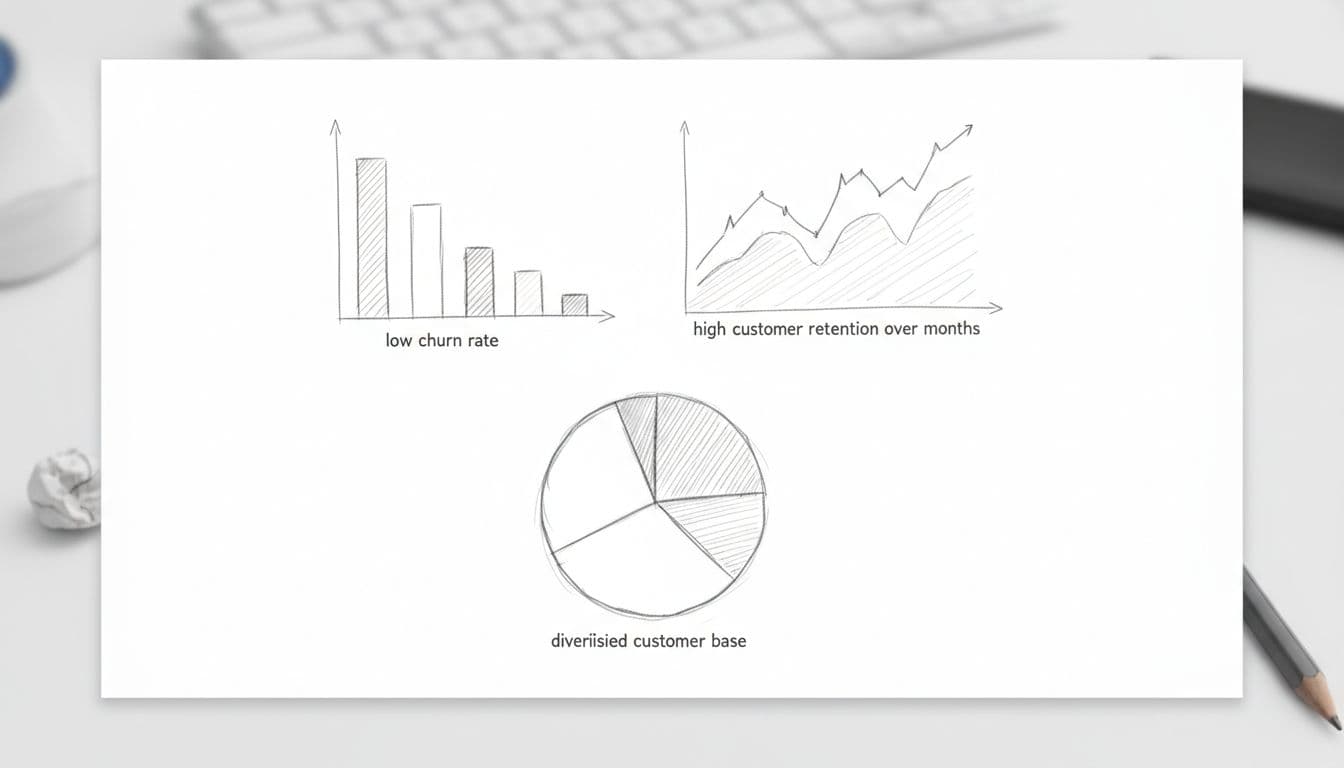
Retention tells a simple story. Do customers stay, or do they leave?
If too many customers cancel each year, recurring revenue stops looking recurring. Buyers notice this quickly. High sales growth can hide the problem for a while, but weak retention usually catches up in due diligence.
Churn measures the revenue or customers you lose. Lower churn tends to support a stronger valuation because it suggests satisfaction, product fit, and staying power. Net revenue retention, or NRR, goes one step further. It shows whether your existing customers are spending more over time, after losses and downgrades are taken into account.
Here is a quick sense of how buyers tend to read those signals:
| Metric | What buyers usually see |
|---|---|
| Low churn | Stable customer base, lower revenue risk |
| High retention | Better future visibility, stronger cash flow quality |
| NRR above 100% | Existing customers are expanding, not only renewing |
| NRR below 100% | Growth may rely too heavily on constant new sales |
In parts of the 2026 market, NRR above 110% can support a premium. Below 100%, buyers often apply a discount.
Contract length, customer concentration, and revenue visibility
A 24-month contract is not the same as a monthly rolling agreement. Both may be recurring, but one gives more certainty.
Longer contracts, renewal history, and clear notice periods usually strengthen valuation. They reduce the risk of sudden revenue loss after completion. By contrast, short notice periods, informal renewals, or verbal arrangements weaken confidence.
Customer concentration matters too. If 40% of recurring revenue comes from one client, that income is less secure than it looks. Buyers want diversification. They want to know that no single customer can damage the business by leaving or renegotiating hard.
Revenue visibility is the practical result. Can you show what is likely to bill next month, next quarter, and next year? If you can, the valuation discussion becomes more robust.
Growth, margin, and the Rule of 40
Recurring revenue on its own is good. Recurring revenue that grows and stays profitable is better.
Buyers usually look at growth rate and margin together. A business adding new recurring customers at pace, whilst keeping gross margin and EBITDA margin healthy, looks more scalable and more defensible. If growth is expensive and margins are weak, the story becomes harder.
This is where the Rule of 40 often enters the discussion, especially for software-led SMEs. It combines revenue growth and profit margin. If the total is above 40, the business often looks healthier than peers. It is not a law. It is a shorthand. But buyers, investors, and advisers use it because it helps separate efficient growth from costly growth.
How recurring revenue changes the main valuation methods
Recurring revenue does not replace valuation methodology. It changes how those methods are applied, and how much trust a buyer places in the output.
That matters whether you are preparing for a sale, discussing investment, or dealing with an HMRC-related valuation.
EBITDA multiples become more attractive
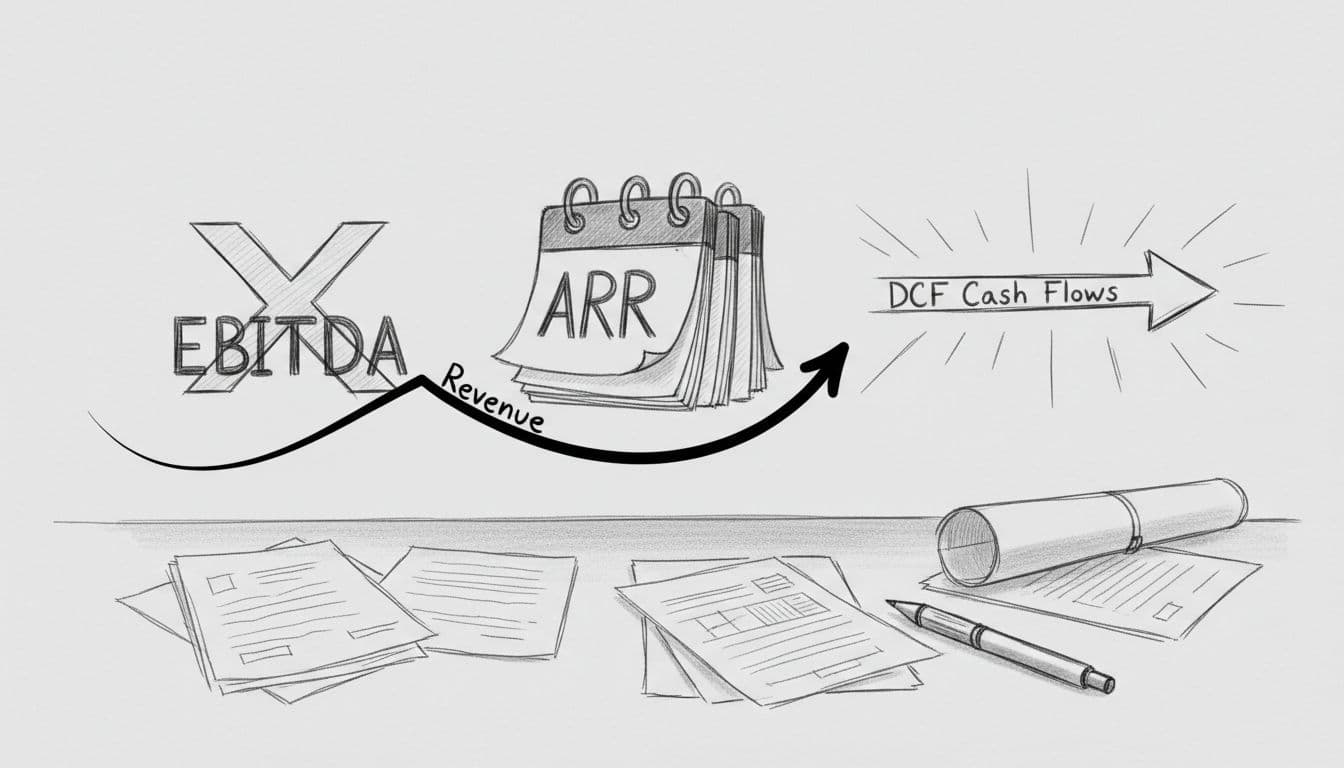
For many SMEs, EBITDA multiples remain central.
When earnings are supported by contracted or repeatable revenue, buyers often see those earnings as safer. That can justify a higher multiple. It can also reduce the size of the discount they might otherwise apply for customer volatility, weak forecasting, or owner dependence.
The key point is this. Buyers care about quality of earnings as much as the earnings figure itself. A business with slightly lower EBITDA but stronger recurring income can be worth more than a business with higher EBITDA built on irregular projects.
ARR and revenue multiples become more relevant
For subscription and software-led SMEs, annual recurring revenue can become a leading valuation measure.
That does not mean every business with monthly billing gets an ARR multiple. Buyers still test growth, churn, margin, product fit, and market confidence. But when the model is genuinely recurring, ARR becomes more useful because it captures the revenue base the buyer is actually acquiring.
In the current UK market, slower recurring businesses may sit nearer 3x to 4x ARR. Healthy growing B2B businesses often sit closer to 4x to 6x ARR. Stronger operators with better retention and growth can move higher. The multiple is never only about the revenue type. It is about how durable that revenue looks under scrutiny.
Discounted cash flow becomes less uncertain
DCF is only as good as the forecast behind it.
When revenue is lumpy, the forecast can become a chain of assumptions. Win rates, sales timing, project renewals, founder relationships, and market swings all have to be estimated. That makes the output easier to challenge.
Recurring revenue improves this. Future cash flows are not guaranteed, but they are easier to model with evidence. Renewal rates, historic churn, contract terms, and customer expansion all give a firmer base for forecasting. For owners, that often means a valuation that is easier to defend in front of buyers, investors, and HMRC.
How to increase valuation by strengthening recurring revenue
Improving valuation is not about dressing the business up for sale. Buyers see through that. It is about improving the business model so the valuation has stronger foundations.
Reduce churn and improve customer stickiness
If customers leave too easily, value leaks out of the business.
Start with the basics. Better onboarding, clearer service delivery, regular account reviews, faster issue resolution, and stronger customer success all help. So does understanding why customers cancel and fixing the root cause rather than treating churn as normal.
Retention is one of the clearest value drivers because it affects revenue, margin, forecasting, and confidence at the same time.
Build more contracted and repeatable income
Many SMEs can move part of their model away from one-off work.
That might mean monthly retainers instead of ad hoc consulting. It might mean maintenance contracts after installation work. It could mean software support, compliance reviews, annual renewals, or multi-year service agreements. The structure will vary by sector, but the aim is the same, income that repeats without being resold from scratch each month.
The closer your revenue model gets to repeatable, contracted, and visible income, the stronger the valuation case becomes.
Show clean records and reliable reporting
Good recurring revenue still needs proof.
Buyers want clean management accounts, reliable deferred revenue treatment, contract schedules, retention analysis, and clear evidence that billed income matches the underlying customer arrangements. If reporting is patchy, even a strong business can look weaker than it is.
This is where partner-led valuation advice matters. A credible valuation is not only a number. It is the method, the evidence, and the way the case is presented. Consult EFC helps SMEs prepare figures that stand up to buyer, investor, and HMRC scrutiny. That can make a material difference when the stakes are high.
Conclusion
Recurring revenue changes SME valuation because it reduces uncertainty. Buyers can forecast more confidently, trust earnings more readily, and apply stronger multiples when the income base is stable.
For UK business owners, the message is simple. Quality of recurring income matters as much as quantity. If your contracts are sticky, your retention is strong, and your reporting is clean, the business is usually worth more, and easier to defend. That is the proper way to build value, not for optics, but for the outcome.
Not sure what your business is worth right now?
Request a confidential valuation — ICAEW Chartered Accountants, Big Four trained. No junior analysts. Fixed fees.
Request My Valuation
Over 12 years across Big Four audit, Investment Banking and corporate advisory. Kishen works with UK SMEs on valuations, exit planning, fundraising and financial strategy. ICAEW regulated. Big Four trained. Based in London.