“How much is my business worth in the UK?” is one of the most common questions founders ask, and the honest answer is usually a range, not a single figure.
That range depends on profit, risk, growth, cash flow, sector, and buyer demand. A strong business with clean numbers can command a healthy multiple. A similar firm with messy accounts or heavy founder reliance may not.
If you’re planning to grow, raise investment, or think about an exit, it helps to know what drives value in a UK SME. The sections below explain the main valuation methods, what is moving prices in 2026, and how to get to a figure that stands up when someone serious checks the numbers.
The quickest way to estimate how much your business is worth in the UK
For many UK SMEs, the fastest first-pass estimate starts with maintainable profit and a multiple.
A multiple is simply a number a buyer applies to profit. If your adjusted EBITDA is £500,000 and the right multiple is 4x, the enterprise value may be around £2 million. If the same profit attracts 6x, value rises to £3 million. The number matters because it reflects risk, quality, and future potential.
This is why two firms with similar turnover can have very different values. Buyers don’t pay for sales alone. They pay for reliable earnings and confidence that those earnings will continue after completion.
A rough guide helps frame expectations:
| Business profile | Common profit basis | Typical SME range |
|---|---|---|
| Small owner-managed firm | Seller’s discretionary earnings | 2x to 4x |
| Established SME with solid systems | Adjusted EBITDA | 3x to 6x |
| Higher-growth specialist business | Adjusted EBITDA | 5x+ where risk is low |
These are only guides, not promises. In April 2026, buyers remain selective, so the lower and upper ends of the range depend heavily on risk.

Why buyers focus on maintainable profit, not just last year’s sales
Revenue gets attention, but profit pays the bills. A business with £2 million of sales and weak margins may be worth less than one with £1.2 million of sales and strong cash generation.
Buyers look for maintainable profit, which means the earnings they believe can continue. That often means normalising the accounts. One-off legal costs might be removed. Excess owner salary may be adjusted. Personal costs put through the business may be stripped out. A temporary profit spike may also be reduced if it won’t repeat.
That process can change value sharply. Headline accounts often tell only part of the story.
When a revenue multiple matters, and when it does not
Revenue multiples can matter in software, subscriptions, and some high-growth firms. They are more common where current profit is low but future value looks strong because recurring income is building.
Still, most traditional SMEs are judged more on earnings and cash. If a business relies on project work, low margins, or inconsistent sales, revenue alone says little about what a buyer will pay.
In plain terms, turnover can support the story, but profit usually sets the price.
The main ways UK businesses are valued
A proper valuation rarely rests on one method alone. Good advisers test the business from more than one angle, then settle on a sensible range.
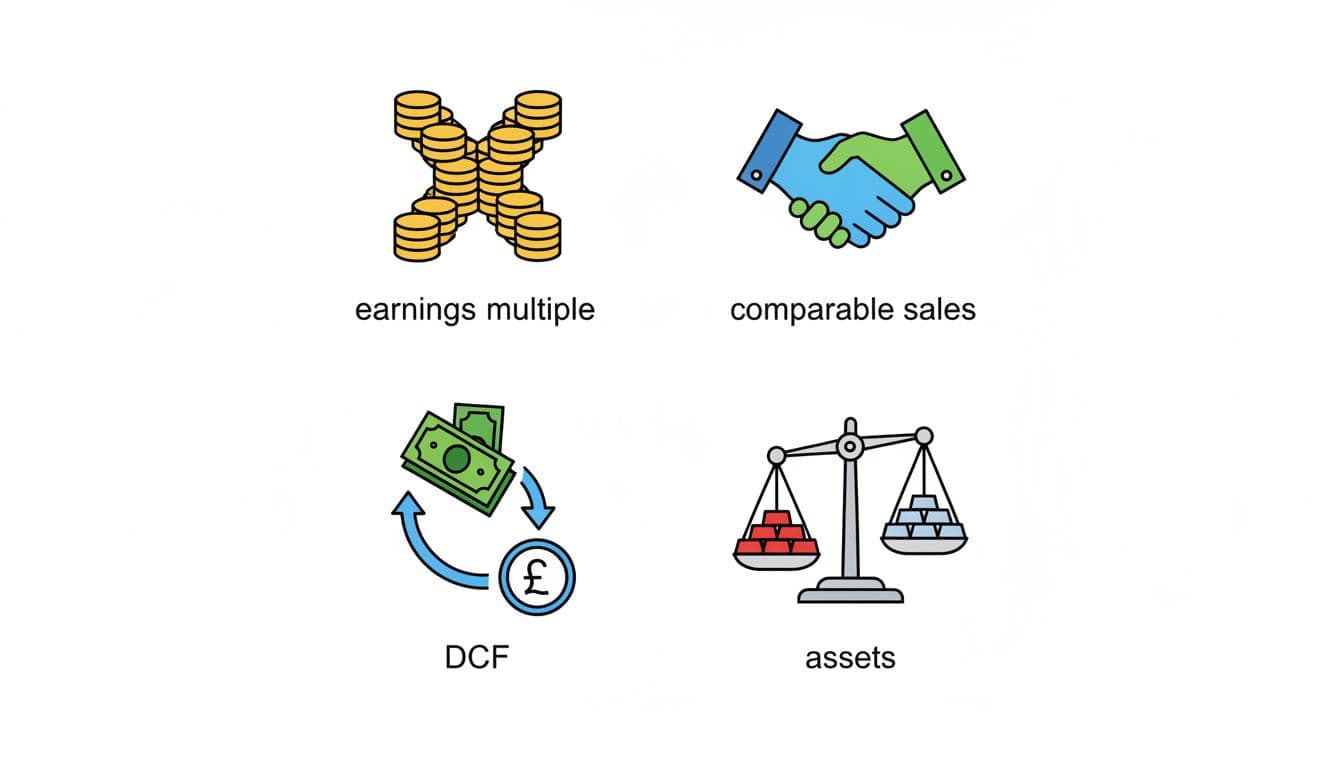
Earnings multiples, the most common method for many SMEs
This is the method most founders hear about first, and for good reason. It fits many trading businesses.
The starting point is EBITDA, or another adjusted earnings measure. That figure is then multiplied by a sector and risk-based number. A business with stable clients, recurring income, and a strong second-tier team can attract more. One with falling margins or shaky controls will attract less.
Current market conditions matter as well. In 2026, slower growth, tighter lending, and cost pressure mean buyers are testing downside harder. As a result, multiples are more sensitive to risk than they were in easier markets.
Market comparables, what similar businesses have sold for
Comparables look at what similar companies achieved in real transactions. This sounds simple, but context changes everything.
Size matters. Margin matters. Customer mix matters. So does location, management depth, and whether the founder can step away.
A sale story without the underlying numbers is usually gossip, not evidence.
If someone says a business sold for 7x, you still need to know what profit measure was used, what was included, and whether deferred or earn-out payments formed part of the deal.
Discounted cash flow, useful when future cash can be forecast with confidence
A discounted cash flow, or DCF, works by valuing future cash in today’s money. It can be useful for investor discussions, long-term planning, and businesses with a clear forecast path.
However, it is only as strong as the forecast behind it. If revenue is uncertain, margins are moving, or working capital swings sharply, the model becomes fragile. A DCF can still help shape thinking, but it should not create false certainty.
Asset-based valuation, often used when the business owns valuable assets
This method adds up assets and subtracts debts. It tends to matter more for asset-heavy firms, such as manufacturing businesses, property-linked operations, or companies heading towards a wind-down.
That said, asset value and trading value are not the same. A profitable company may be worth more than its net assets because of goodwill, customers, and future earnings. On the other hand, a business with weak profits may lean heavily on asset support.
What makes a business worth more, or less, in 2026
The market does not reward effort alone. Buyers pay for quality, trust, and the chance of future returns with manageable risk.

Strong recurring income, healthy margins, and reliable cash flow push value up
Predictable income is attractive because it lowers fear. A business with repeat orders, contracted revenue, or low churn is easier to underwrite than one starting each month from zero.
Margins matter too. Buyers look at gross margin stability, not only headline growth. If costs are under control and cash converts well, confidence rises. Debtors that pay on time, sensible stock levels, and limited surprise spend all help.
In many cases, predictability is worth as much as growth. Fast growth with poor cash control can still worry a buyer.
Owner dependence, customer concentration, and messy accounts drag value down
A founder-led SME often carries hidden risk. If every major sale, supplier issue, and client relationship runs through one person, the business becomes harder to transfer.
Customer concentration can also hit value. If one or two clients account for a large share of turnover, a buyer will ask what happens if they leave. The same goes for weak systems, delayed reporting, unclear KPIs, and unresolved tax or legal issues.
Poor records do not only slow a deal. They reduce confidence, and lower confidence often means a lower multiple.
How 2026 UK cost pressures can affect valuation
From 1 April 2026, the National Living Wage for workers aged 21 and over rises to £12.71 an hour. Rates also increase for younger workers and apprentices. For labour-heavy SMEs, that can squeeze margin unless pricing and productivity keep pace.
Corporation tax remains at 19% up to £50,000 of profit, 25% above £250,000, with marginal relief between those points. So, tax planning still affects net cash and distributable profit. The personal dividend tax position also matters for owners weighing sale timing and extraction strategy, even though the core corporation tax bands are unchanged.
Business rates are also shifting. New rateable values apply from 1 April 2026 in England and Wales, and some firms will see higher property costs. Add tighter funding markets and softer buyer confidence, and profit pressure can quickly reduce the multiple on offer.
How to get a realistic valuation before you raise, sell, or plan your next move
A valuation becomes more credible when the evidence is clean, current, and easy to follow. That matters whether you are speaking to investors, lenders, HMRC, or a buyer.

The numbers and documents you should have ready
Start with the basics, then tighten the detail. Most founders should have:
- Recent statutory accounts and up-to-date management figures
- A clear breakdown of revenue by customer, product, and contract type
- Evidence of recurring income, renewal rates, and churn
- Gross margin and EBITDA trends over time
- Debt, leases, and any unusual liabilities
- A sensible forecast with key assumptions
- Staff structure, including who owns key relationships
- Major customer or supplier contracts
Clean information builds trust. It also speeds up challenge and review. If someone has to guess what the numbers mean, they will usually assume the risk sits on the high side.
Why a valuation range is more useful than chasing the highest number
A sensible valuation range helps you make better decisions. It gives you room to judge timing, funding options, succession, and exit strategy without clinging to an unrealistic headline.
This matters because the best valuation is not the highest number on paper. It is the number that survives diligence, market testing, and negotiation.
A strong valuation is one a serious buyer, investor, or HMRC reviewer can accept after seeing the evidence.
For growing SMEs, that often means improving the business before pushing for a deal. Better reporting, stronger margins, less founder dependence, and more predictable revenue can all move value in the right direction.
Final thoughts
Your business value in the UK is shaped by earnings quality, cash flow, growth, sector, risk, and the market you are selling into. Price is rarely fixed, and it is never based on hope alone.
Founders can improve value by tightening reporting, reducing owner reliance, protecting margins, and building revenue that buyers trust. Those changes do not only help at exit. They help the business run better now.
When the number needs to stand up to investors, acquirers, or HMRC, proper advice matters. Consult EFC can help you reach a valuation that is investor-ready, buyer-ready, and grounded in the realities of the UK market.
Not sure what your business is worth right now?
Request a confidential valuation — ICAEW Chartered Accountants, Big Four trained. No junior analysts. Fixed fees.
Request My Valuation
Over 12 years across Big Four audit, Investment Banking and corporate advisory. Kishen works with UK SMEs on valuations, exit planning, fundraising and financial strategy. ICAEW regulated. Big Four trained. Based in London.